If you’ve never worked with a freight broker before, the process can seem intimidating. But the truth is—it’s actually pretty straightforward. Freight brokers are simply the middle people who connect shippers (like us) with trucking companies. Their job is to find a carrier to move your freight, and your job is to make sure you’re getting a fair rate.
Step 1: Understand the Broker’s Role
Think of a broker as a matchmaker. You tell them what you need moved—how many pallets, the weight, where it’s going, and when it needs to arrive—and they come back with a quote.
Step 2: Know That Negotiating Is Normal
This is important: in freight, negotiation isn’t rude—it’s expected. When a broker gives you a rate, your first response doesn’t need to be “yes.” Instead, you can ask questions like:
“Can you do better?”
“That seems high—what’s your best rate?”
“We usually pay around [X amount] for this lane. Can you match or beat that?”
Often, just by asking, you’ll get a lower rate.
Step 3: Keep It Polite, Clear, and Direct
The key is to be professional and respectful while still pushing for better pricing. You don’t need long explanations—simple, confident questions usually work best.
Step 4: Build Relationships Over Time
The more often you work with a broker, the more likely they’ll be to automatically offer you better rates. They want repeat business, and they’ll reward you for consistency.
Step 5: Track Your Numbers
Keep a record of what you’ve paid for similar shipments in the past. This gives you leverage when negotiating because you can confidently say what’s “normal” for that lane.
Quick Takeaway
Working with freight brokers comes down to three things:
Tell them what you need shipped.
Ask for a lower rate—it’s expected.
Be polite but firm, and build a relationship for better deals in the future.
I’m not a developer. Let me just get that out there. I’m a commerce guy who gets excited about technology, and what I’m seeing right now is blowing my mind.
Six months ago, I couldn’t have imagined writing a line of code. Today? I’m playing around with Cursor, experimenting with no-code tools, and I’ve actually got an IDE running on my Mac. Am I building the next Facebook? No. But I’m creating small, useful software for my specific needs. And that’s the point – we’re entering an era where everyone can be a builder.
The Great Unbundling
Here’s what hit me this week: Everything is decentralizing, and it’s happening faster than most people realize.
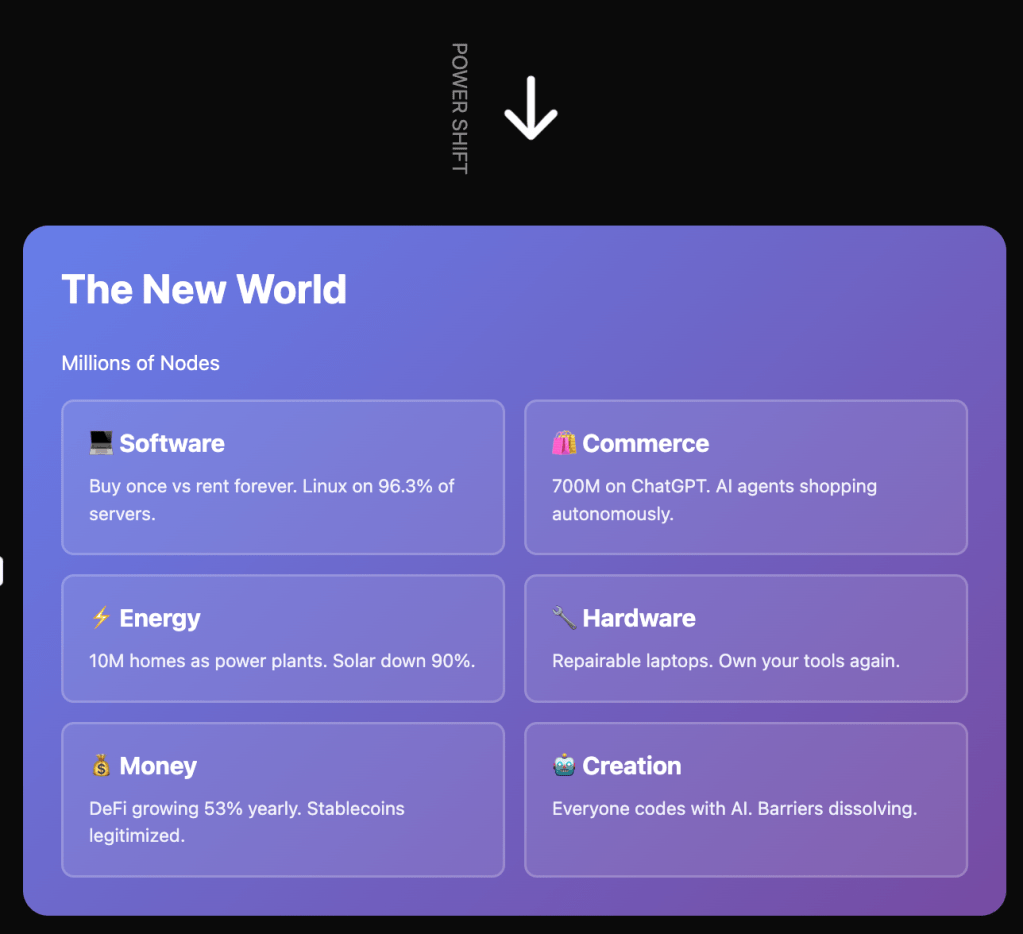
Rails World 2025 just wrapped up in Amsterdam (literally two days ago!), and while I wasn’t there, I’ve been catching up on all the buzz. Last year at Rails World 2024, DHH unveiled OMAKUB – basically Ubuntu Linux that you can set up with one command. But here’s what stuck with me: Linux runs on 96.3% of the top one million web servers. This free, open-source operating system that thousands of developers have worked on for 30+ years essentially is the internet.
Then earlier this year, 37signals dropped Campfire – a chat tool like Slack that you buy once for $299 and host yourself. No monthly fees. Forever. DHH literally ran a conference chat from a computer in his closet to prove the point. In his blog post about it, he said it best: “SaaS has been ruling the world of web-based software for two decades now… But there’s also a lot of SaaS that does not need to be a service.”
Why does this matter? Because we’ve been sleepwalking into a world where we rent everything and own nothing.
The “Why Are We Doing This?” Moment
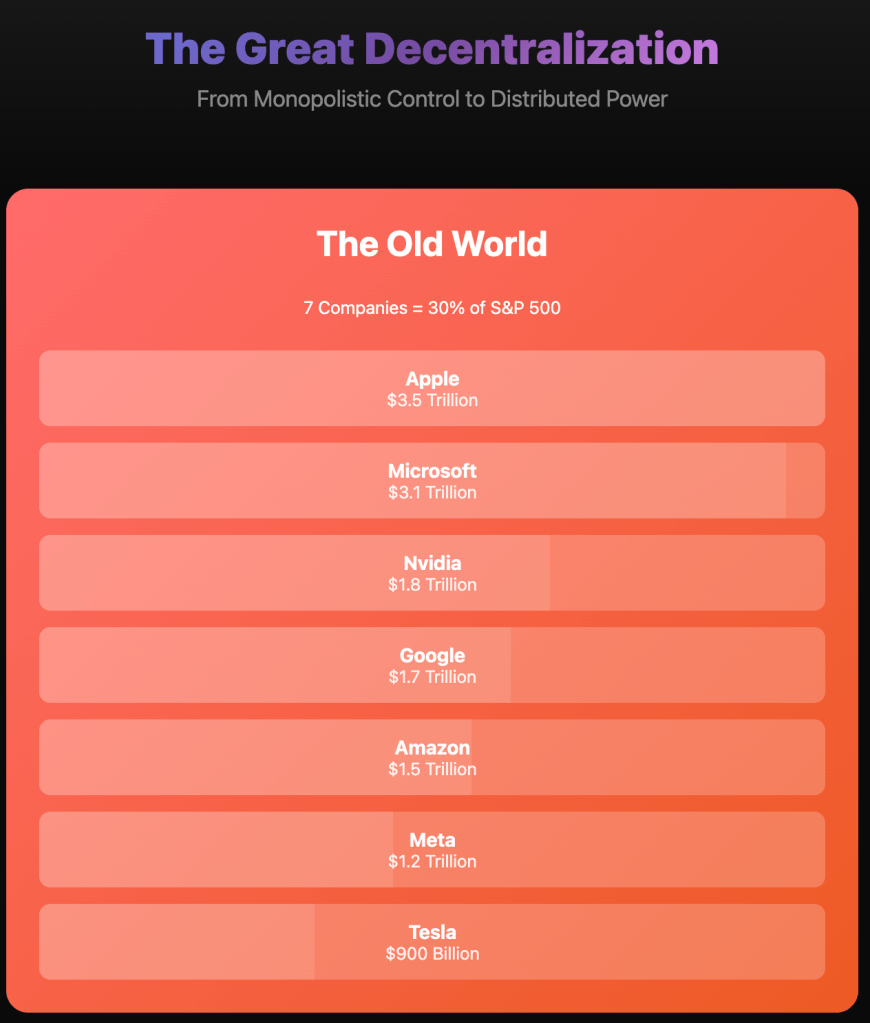
Let’s be real for a second. Why are five companies basically running the American economy? Why does every business decision, every communication, every piece of data flow through the same handful of Silicon Valley giants?
I’m not saying these companies are evil. They built incredible things. But we’ve reached a point where the concentration of power doesn’t make sense anymore. The tools to build alternatives exist. The hardware is powerful enough. The networks are fast enough.
So why are we still paying monthly fees forever just to chat with our coworkers?
Chamath Palihapitiya, the former Facebook exec turned venture capitalist, has been saying this for years. He famously called social media tools “ripping apart the social fabric of how society works” and predicted big tech companies will be “taxed to death” and face regulatory breakup. Back in May 2024 on the All-In Podcast (at the 53:00 mark), he predicted Bitcoin could hit $500,000 by October 2025 – we’re just a month away from his deadline, and while we’re not quite there yet, the momentum toward decentralization he was talking about is undeniable.
The Commerce Revolution I’m Actually Excited About
As someone in commerce, this shift is personal for me. For too long, online selling meant choosing between Amazon, Shopify, or maybe one or two other platforms. A handful of retailers have controlled how products reach consumers.
But that’s changing. Fast.
We’re seeing:
Creator commerce where individuals build direct relationships with customers
Video commerce that’s more like QVC meets TikTok than traditional e-commerce
Decentralized marketplaces where sellers actually own their customer relationships
Token-based systems that let communities govern themselves while still maintaining order
The DeFi market is projected to grow from $20.48B in 2024 to $231.19B by 2030 – that’s a 53.7% annual growth rate. This isn’t chaos – it’s organized decentralization. We can have rules and systems without having overlords.
The Hardware Finally Catches Up (And My Personal Connection)
Ok, here’s where it gets personal for me. I grew up in the 80s and 90s, and man, those were beautiful times for a computer nerd. From kindergarten through high school, I spent my days at my dad’s computer shop. Seven days a week, we were building PCs, servicing PCs, living and breathing PCs.
I watched us go from DOS to Windows 3.1 (which was mind-blowing at the time), then to Windows 95, which felt like the future had arrived. We were constantly upgrading – swapping out sound cards (remember Sound Blaster?), video cards, adding memory. Going from a 256MB hard drive to 512MB felt like you’d just bought a mansion. Every component was a choice, an upgrade path, a possibility.
Then laptops happened. And suddenly, you buy a MacBook, something breaks, you buy a new MacBook. Dell laptops? Same story. The whole beautiful ecosystem of modular computing just… died. It’s been insane, honestly.
Enter Framework. They’re making laptops where you can swap out ANY component. Screen breaks? Replace the screen. Need a faster processor? Swap it out. Want better graphics? Pop in a new module – takes 5 minutes. They announced earlier this year you can upgrade from an RX 7700S to an RTX 5070 in their Framework 16.
And here’s the beautiful part: AMD’s latest chips are now legitimately competitive with Apple’s M-series. You can get MacBook-level performance in a machine you actually own and can repair. For someone who grew up in the era of “open it up and tinker,” this feels like coming home.
Linus Tech Tips invested $225,000 of his own money in Framework because he believes in this vision so strongly. The Framework laptop got a 10/10 repairability score from iFixit. For the past decade, laptops have been expensive disposable items. That’s ending.
The Money Thing We Need to Talk About
The U.S. is now actively moving on cryptocurrency regulation and adoption. The GENIUS Act (Guiding and Establishing National Innovation for U.S. Stablecoins of 2025) was just signed into law in July 2025 – creating the first federal regulatory framework for stablecoins. This bipartisan legislation, which passed 68-30 in the Senate and 308-122 in the House, requires stablecoins to be backed 1:1 by US dollars or low-risk assets.
Major banks like JPMorgan Chase and retailers like Amazon and Walmart are already planning to issue their own stablecoins. The Act positions the US to lead the global digital currency revolution while strengthening the dollar’s reserve currency status – stablecoins will actually drive demand for US Treasuries. Additionally, 19 US states have introduced Bitcoin reserve legislation as of late 2024.
Whether you love or hate crypto, you can’t ignore what this represents: even governments are recognizing that centralized control of money might not be the only way forward.
This isn’t about becoming a crypto bro. It’s about recognizing that the fundamental structures of our economy are becoming more distributed. And that’s probably healthy.
What This Actually Means for Regular People
Here’s why I’m writing this on a Sunday morning, coffee in hand, genuinely excited about the future:
We’re becoming creators, not just consumers.
When I fire up Cursor and start building something, I’m not trying to create the next unicorn startup. I’m solving my own problems. Creating tools for my specific needs. The stats are wild – 76% of developers are using or planning to use AI coding assistants, and they’re seeing 26% productivity increases.
But here’s the real kicker – you don’t need to be a developer anymore. I’m living proof. Six months ago, code was gibberish to me. Now I’m building stuff. Not perfect stuff, not production-ready stuff necessarily, but MY stuff. Tools that solve MY problems.
This is the real revolution: The barriers between “technical” and “non-technical” people are dissolving. My kids will grow up in a world where creating software is as normal as creating a PowerPoint presentation is today.
The Framework for Everything
What we’re seeing isn’t just about Linux or laptops or Bitcoin. It’s a fundamental shift in how we think about ownership, creation, and power:
Own, don’t rent – Whether it’s software (Campfire for $299 once), hardware (Framework laptops), or digital assets
Build for yourself – The tools are accessible enough that you can solve your own problems (I’m doing it with Cursor!)
Participate, don’t just consume – Whether it’s open source, DAOs, or creator economies
Modularity over monoliths – In hardware, software, and business models
Where We Go From Here
The beautiful thing about this movement is that it’s not theoretical. You can participate today:
Try Linux: With tools like OMAKUB, it’s genuinely easy now – one command and you’re running
Build something: Even if you’re not technical, tools like Cursor make it possible (trust me, if I can do it…)
Buy hardware that lasts: Framework laptops exist today – and they’re actually good
Support decentralized commerce: Buy directly from creators when possible
Question the subscription model: Do you really need to rent that software forever?
The Bottom Line
We’re living through a profound shift. The age of five companies controlling everything is ending. Not because of regulation or revolution, but because better alternatives are emerging.
The centralized model made sense when coordination was hard and resources were scarce. But we’re past that now. We have the tools, the networks, and the knowledge to build differently.
What excites me most isn’t the technology itself – it’s what it enables. When everyone can build, when commerce is truly peer-to-peer, when we own our tools instead of renting them, we get a more vibrant, creative, resilient economy.
That’s not just cool. That’s transformative.
And the best part? We’re just getting started. Rails World 2025 just showed us that the community pushing for this change is stronger than ever. The momentum is real. The future is decentralized.
These are my Sunday thoughts as a non-technical person watching the tech world transform. I’m curious – what changes are you seeing in your industry? How is decentralization showing up in your world?
P.S. – If you’re like me and thought coding was impossible, seriously, try Cursor or another AI-assisted tool. You might surprise yourself with what you can build. I sure as hell did.
Resources & Links
Want to dive deeper? Here’s where I’ve been learning:
I’m sitting in our warehouse this Sunday morning, July 13th, surrounded by moving boxes. We just wrapped our team meeting, and I finally have time to share something I’ve been building in the evenings after the kids go to bed.
If you work in home furnishings—whether you’re a buyer, designer, manufacturer, or retailer—you know the morning ritual. Open Furniture Today. Check Home Accents Today. Scan Architectural Digest. Pop over to Apartment Therapy. By the time your coffee’s lukewarm, you’ve got a dozen tabs open and you’re still not sure you caught everything important.
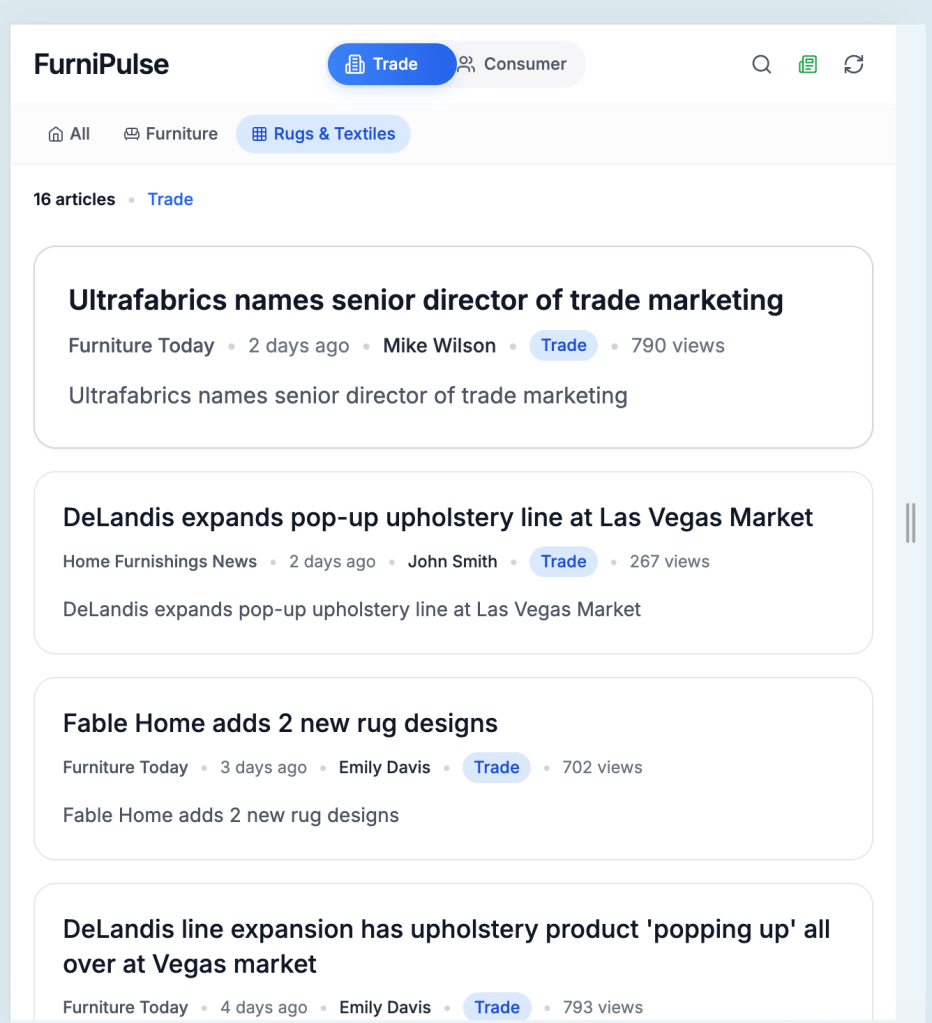
Last month, I decided to come up with a solution. The result? FurniPulse—a simple tool that pulls 19+ furniture industry sources into one clean feed, updated every 20 minutes.
The Pulse of the Business
In the furniture industry, any good company needs to know where the consumer mindset is and what’s happening in the competitive landscape. There’s SO much going on all the time—new collections dropping, trends shifting, competitors making moves, trade shows approaching.
(Quick sidebar: you need to know what’s going on, but you also need your own vision. Like, I check what West Elm is doing, but I’m not trying to BE West Elm, you know? It’s more like… okay, they’re pushing curved sofas hard this season. Good to know. But maybe my customers are still loving their sectionals. You can’t just chase every trend—you’ll drive yourself crazy and lose what makes you unique.)
If I’m being perfectly honest, there’s definitely some FOMO mixed in there too. You see a competitor mentioned in a trade pub and think “what are they up to?” Or a design blog features some trend you haven’t heard of and suddenly you’re wondering if you’re behind the curve.
Every morning, I’d find myself with a dozen tabs open, trying to piece together the full picture. Trade news in one corner telling me about manufacturing changes. Consumer blogs in another showing me how those changes were being spun to the public. Industry announcements scattered across five different sites.
This is just what we do. It’s part professional necessity, part curiosity, part not wanting to be the last one to know something important. But I kept thinking—there has to be a better way to stay connected to all this without the constant tab juggling.
So I thought: why not create this for myself? One place where I could actually feel the rhythm of the industry without the morning scramble. A single feed that shows me both sides of the story—what manufacturers are saying and what consumers are reading.
That’s how FurniPulse was born. Not from crisis or frustration. More from recognizing that this thing we all do—this mix of staying informed and maintaining our own direction—could be simpler.
Building Without Being a Builder
Here’s the part that still amazes me: I built this myself. Me. A furniture guy who couldn’t write a line of code six weeks ago.
With all these AI coding tools dropping—Cursor, Claude, ChatGPT—I started wondering: could I actually build something to solve my own problem? Not hire someone. Not wait six months. Just… build it myself?
So I did. Over the last few weeks, spending a couple hours each evening, I created FurniPulse. The process was surreal. I’m literally talking to these tools using Whisper AI, explaining what I want like I’m training a really smart intern. Share a screenshot here, describe a feature there, and somehow, working code appears.
My wife would find me at 11 PM, muttering at my laptop about RSS feeds and Python scripts. “Are you becoming one of those tech guys?” she’d ask. Maybe I am.
Consumer Mode – Design trends, home decor, lifestyle content
The magic is in seeing both perspectives side by side. You start to notice things.
The Patterns You Can’t Unsee
Once I had both trade and consumer feeds in one place, the matrix revealed itself:
The 48-Hour Rule: Trade news hits consumer blogs 48-72 hours later, like clockwork. Tariff announced Monday? By Wednesday, Apartment Therapy has “5 Ways to Style Your Space Before Prices Rise!”
The PR Playbook: Product launches follow a script—leaked photo, official announcement, influencer “surprise” post, consumer blog round-up. Every. Single. Time. Now I can practically predict which stories will blow up.
Market Momentum: Vegas Market prep started ramping up exactly 6 weeks out across every publication. The cascade is so predictable, you could set your calendar by it.
The Translation Gap: What manufacturers call “supply chain optimization” becomes “Why Your Favorite Sofa Might Cost More” in consumer media. Watching how industry jargon gets translated for consumers is a masterclass in communication.
The Technical Journey (For Fellow Non-Techies)
I spent three nights googling “how to parse RSS feeds” before realizing I was massively overthinking it. The fourth night, I had a working prototype.
The tools I used:
Cursor on my Mac (it’s like VS Code but understands plain English)
Claude/ChatGPT for problem-solving
Whisper AI for voice-to-text (because typing is slow when you’re excited)
Python for the backend (which I learned as I went)
Some hosting service I still don’t fully understand but it works
I almost gave up when I realized I’d have to manually categorize 47 different publications. Some use “furnishings,” others “furniture,” and don’t get me started on whether “décor” needs an accent. Then I remembered: done is better than perfect.
The biggest surprise? It’s ridiculously cheap to run. Like, less than my monthly coffee budget cheap.
What This Means for Our Industry
We’re at an inflection point. When a furniture guy can build software by talking to AI at 11 PM, what else becomes possible?
Think about all the inefficiencies in our industry:
Inventory management spreadsheets that haven’t changed since 2003
Quote processes that still involve three emails and a PDF
Showroom experiences that ignore everything we know about digital retail
If I can solve my news problem in a few weeks of evenings, what could you build to solve yours?
The Reality Check
FurniPulse isn’t perfect. My wife thinks the name is terrible (she’s probably right). I still manually check Dwell because their RSS feed is broken. Sometimes the categorization is wonky—apparently “ottoman” can mean furniture OR the empire, depending on context.
But every morning when I open one tab instead of twelve, when I catch trends before they hit mainstream, when I save 30 minutes that I can spend on actual business—it’s worth it.
What’s Next
Right now, my goal is simple: get feedback. Is this useful beyond my own morning routine? What sources am I missing? How could it be better?
I’m not thinking about monetization. Maybe sponsors down the line, but that’s a careful road. For now, it costs almost nothing to run, and if it helps others in our industry stay informed, that’s enough.
Once we get through this warehouse move and into fall, I want to create more tools like this. Share what works. Build in public. Because if there’s one thing I’ve learned, it’s that the gap between “I wish someone would build…” and “I built…” is smaller than ever.
Try It Yourself
FurniPulse is live at furnipulse.com. It’s free, it’s basic, but it works.
If you’re drowning in furniture industry news every morning, give it a try. And if you know of publications I’m missing, please let me know. Currently tracking 19 sources, but our industry is vast and I’m always looking to improve.
More importantly, if you’ve got your own itch to scratch—that spreadsheet that drives you crazy, that process that wastes hours, that information gap that costs money—maybe it’s time to build your own solution.
All of us are techies now, whether we admit it or not.
Drop me a line at adam@woven.com. I’d love to hear what you think, what you’d build, or just commiserate about the state of RSS feeds in 2024.
Time to get back to these moving boxes. But first, one more coffee and a quick check of FurniPulse. Old habits die hard—they just get more efficient.
—Adem
P.S. – Still looking for someone who can fix Dwell’s RSS feed. Coffee and eternal gratitude await.
I run a rug company. Not a SaaS startup. Not a VC-backed AI darling. A company that makes beautiful, easy-to-clean rugs for real people with real messes — peanut butter on a runner, juice spills at a birthday party, you name it.
But recently, I’ve been falling down the rabbit hole of AI-powered tools — not because I think they’re flashy, but because they’re finally getting useful. And nothing caught my eye more than the last couple of Y Combinator graduating classes.
A massive chunk of these startups are building AI tools. But here’s what gets me excited: many of them aren’t chasing the moon. They’re solving the real, unsexy, painful problems small businesses like mine deal with every day. Logistics. Invoicing. Bookkeeping. Government paperwork. Refund fraud.
This post isn’t meant to be a full YC recap. It’s just a short list of companies I think are worth watching — and why they matter to folks who are actually running businesses, not just building pitch decks.
Five Startups I’m Keeping an Eye On
1. Hazel
What they do: Hazel helps small businesses win government contracts by automating the messy paperwork and compliance steps. Think of it like an AI-powered RFP assistant.
Why it matters: Government work used to be a fortress unless you had connections, patience, and legal muscle. Hazel opens the door for small shops — contractors, designers, local manufacturers — to land serious clients like school districts and city agencies.
Try it or reach out:hazeltech.ai | august@hazeltech.ai | elton@hazeltech.ai
2. Oway
What they do: Oway turns unused truck space into cheaper freight shipping. They basically “rideshare” pallet shipping — you toss your freight into someone else’s half-full truck going the same way.
Why it matters: Freight is expensive. For physical product brands, it’s one of the top 3 cost drivers. This is a way to lower that cost without warehousing or bulk negotiating. I’d love something like this for our custom rugs.
What they do: LedgerUp is like an AI revenue assistant. It automates your invoicing, follows up on late payments, and even answers questions like “What did Acme Co. pay last month?” in Slack.
Why it matters: I can’t tell you how many times I’ve had to chase a payment that slipped through the cracks. This tool isn’t flashy — it’s just practical. And when you’re running lean, cash flow is everything.
Try it or reach out:ledgerup.ai | founders@ledgerup.ai
4. Rebolt
What they do: Rebolt is building AI agents to replace back-of-house restaurant tasks. They dispute delivery app refunds, respond to customers, and even help hire and manage staff.
Why it matters: One of our friends runs a restaurant and loses thousands every month to fake refund claims. If Rebolt can claw that back, that’s a game-changer. And honestly, I think their model will spread beyond restaurants.
Try it or reach out:rebolt.ai | founders@rebolt.ai
5. Abundant
What they do: They provide on-demand human oversight for your AI agents. When the bot gets confused, a vetted human jumps in — and their work helps retrain your AI over time.
Why it matters: We all want to automate more. But when AI fails silently, it costs real money. This gives you reliability and a smarter system over time.
Try it or reach out:abundant.ai | founders@abundant.ai
What This All Adds Up To
A year ago, I thought AI was mostly for coders and researchers. Now, it’s clear: AI is becoming the new labor layer. Not the replacement for people — but the relief from all the stuff people hate doing anyway.
That’s what these companies have in common. They’re not building “chatbots” — they’re building quiet systems that plug into the broken workflows we’ve all tolerated for too long.
A Note to Founders
If you’re working on something like this, I’d love to hear about it. I’m just a guy who sells rugs, but I think there’s power in sharing real tools with other operators. These posts aren’t paid. They’re just my way of making sense of what’s happening.
And if you’re a small business owner like me — and you try one of these tools — let me know what you think. There’s something really special happening here, and I want to stay close to it.
Tweet me @ademogu or drop me a line at adem@wellwoven.com. I’ll be posting more of these soon.
As we enter the new year, I wanted to share some thoughts and insights that have been shaping my journey:
Progress Takes Time
Real growth spans years. A recent reunion reminded me of my high school hockey coach, Bart Mucci. As the head coach of Rebels Hockey for over two decades, Bart built the team into a D1 program that now practices four nights a week. During our time from ’99 to ’03 as a club team, we only had one practice and one game weekly. Securing ice time, which can cost between $250 and $650 per hour, was no small feat. Bart and the dedicated parents convinced the Lakeland Central School District that hockey is a key part of our community’s fabric. Their consistency, vision, and passion are inspiring reminders that long-term dedication truly pays off.
The Power of Community
This year highlighted how essential community is to success. Mentors, friends, and vendors have guided me just when I needed it most—sometimes through an offhand comment that sparked a new idea or an email that led to something huge years later. We experienced this firsthand when Amazon froze our funds for five months at the start of the year for an internal audit, compounding an already tough year in ’23. It was brutal, but it taught me never to take anyone for granted. Our community was the only reason we stayed afloat.
Embracing Lifelong Learning and Technology
Advancements in AR/VR and other technologies are making lifelong learning more accessible than ever. Our ability to consume and retrieve information efficiently is evolving, opening up new ways to learn and experience the world. Platforms like Meta Quest offer incredibly lifelike computing experiences, and I’m excited to explore these new frontiers. While we’re still a few generations away from fully seamless hardware, the progress we’re making is unbelievable and real.
Nobody Really Cares
A key theme this year has been the idea that “nobody really cares.” It’s liberating to realize that most people are wrapped up in their own lives and might not spend more than a few seconds on anything you do. Embracing this mindset means shedding the fear of being “cringey” and focusing instead on being the best version of yourself. It’s a powerful reminder to prioritize your goals and well-being without worrying excessively about external judgments.
Hockey, Memories & More
On a lighter note, I got to play hockey again this December with friends I hadn’t seen in 17 years. It took me back to our high school days—’90s kids on rollerblades who transitioned into ice hockey. A big shoutout to Bart Mucci, Bob Santini, Dan Mucci, Steve Poccia, and everyone else who was part of making that team happen. Back in my senior year, we had just one weekly practice session; now, two decades later, they’re on the ice four nights a week. That’s incredible progress.
(RIP Jay Shenkmen—you brought so much laughter, even during those freezing nights at Bear Mountain. You’ll always be in our hearts.)
What I’m Focusing On for 2025
As we step into 2025, my focus areas are:
• Strengthening Our Brand Presence for both Ameritu Trading (wholesale) and Well Woven (consumer).
• Leveraging My 20 Years in the Carpet Industry to share insights and demonstrate our impact.
• Growing a Supportive Community (online and offline) around textiles, home decor, and technology.
• Creating More Content: conducting interviews, improving my questions, and refining my technique. This is a decade-long journey—I’m not trying to be Walter Cronkite overnight, just committed to steady growth.
Some Advice I’ll Leave You With
• Be strong, and allow yourself to be strong. Sometimes you stand up to adversity; other times, you step aside and let it pass.
• Focus on the good stuff. Keep yourself motivated by believing in your abilities and putting in the work.
• Belief + Action = Real Progress.
• Embrace first principles. If your idea or mindset isn’t working, strip it down to the basics and rebuild.
• Tune out the noise. Most people are wrapped up in themselves, so focus on being the best you. Even if you fail, you’ll get closer to your goal.
Guess what? Today was quite the milestone for us at Well Woven. We ventured into our very first structured business review meeting. Imagine us, a bunch of eager beavers, ready to dive deep into the work we’ve been pouring our hearts into across the board – from supply chain planning and merchandising to marketing, operations, IT, and sales. We had this whole agenda planned out, kind of like a treasure map, and for the most part, we stuck to it.
But you know how it goes when passionate people get together. We occasionally veered off into tangents, sparked by questions that led to more questions. Time seemed to stretch a bit further than we’d intended, but hey, it was all in the spirit of digging deeper and understanding better.
The meeting clocked in at a hefty 2.5 hours – a bit of a marathon! But every minute felt like a step towards something truly valuable for our team and for Well Woven as a whole. We got into the weeds of things, ensuring everyone had their moment to shine, to share their insights and thoughts.
Over the next few days, we’re planning to regroup, go through our notes, and exchange feedback on what hit the mark and what missed. It’s all about evolving and improving, right? That’s the core of what we’re trying to do here. Growing not just as a company, but as a team, as a family of sorts.
As the one steering this ship, my aim is to not just lead but to empower everyone on the team to make their impact felt on the business. We’re taking a data-driven approach, eyeing statistical significance to make sure our decisions not only sound good but also hold water.
Today’s meeting, as lengthy and meandering as it might have been, marks the start of this journey we’re on together. Looking forward to the insights we’ll share, the growth we’ll witness, and the path we’ll carve out together at Well Woven.
In the e-commerce sector, staying ahead means constantly reevaluating our strategies. Incrementality is not just a buzzword; it’s a practical approach that can redefine how we engage with advertising and product listings.
Understanding Incrementality
At its core, incrementality measures the additional impact of specific actions. It’s a tool to gauge whether the changes we make in our marketing strategies are genuinely driving new customer interactions and sales.
The Role of A/B Testing
A/B testing serves as a straightforward yet powerful method in this approach. For instance, testing two different rug images on an e-commerce site can reveal which one is more effective in driving conversions. This process offers direct insights into customer preferences and behaviors.
Advertising Through the Lens of Incrementality
In advertising, incrementality helps us look beyond superficial metrics like click rates. By comparing the behaviors of control groups and targeted groups, we can understand the deeper impact of our advertising spend.
Optimizing Product Listings
Experimenting with various elements of product listings, from layout to descriptions, allows us to discover what truly influences customer engagement and sales. It’s a process of continuous improvement, grounded in real data.
Statistical Significance and Statistical Dynamics
A crucial element in all these processes is ensuring the statistical significance of our data. This concept goes beyond the surface-level understanding of data; it’s about being confident that the results we’re seeing are not just random occurrences. Statistical significance is like piecing together a multi-dimensional puzzle – it involves understanding the dynamics of various data points in relation to each other. In this light, we might think of it as ‘statistical dynamics’ – a term that captures the essence of analyzing complex, interrelated data in a way that reveals the true patterns and trends impacting our business.
Conclusion: Practical Insights for E-Commerce Growth
Adopting an incrementality approach in e-commerce means making decisions based on data that is not only significant but also dynamically interrelated. It’s about understanding the complex interplay of various factors that drive customer behavior and sales. In this ever-evolving online marketplace, such an approach enables us to make informed, impactful decisions that lead to measurable growth.
As we navigate through the intricacies of e-commerce, let’s remember that the true power of data lies in its proper interpretation – understanding not just the numbers, but the stories they tell and the dynamics they reveal.
Thinking in the format of a matrix means examining the dimensions that lie behind an idea. This multi-dimensional perspective helps us to look at factors affecting a concept from different angles, leading to a comprehensive understanding. A prime application of this approach can be found in the business context.
Area Rug Qualities Matrix Chart:
Quality Aspect
Durability
Comfort
Aesthetics
Ease of Cleaning
Price Affordability
Material A (e.g., Wool)
High
Medium
High
Low
Medium
Material B (e.g., Nylon)
Medium
High
Medium
High
Low
Design A (e.g., Modern)
Medium
Medium
High
Medium
High
Design B (e.g., Classic)
High
Low
Medium
High
Medium
Marketing Strategy Matrix Chart for Product Y:
Marketing Channel
Brand Awareness
Customer Engagement
Lead Generation
Sales Conversion
Social Media
High
High
Medium
Low
Email Marketing
Medium
Low
High
Medium
SEO
High
Medium
Medium
High
Influencer
Medium
High
Low
Medium
TV Advertising
High
Low
Low
Medium
Matrix Chart Example for Product X’s Sales Driving Factors:
Dimension
Impact on Sales
Page Traffic
High
Conversion Rate
Medium
Seasonality
Low
Trend Analysis
Medium
Competitor Position
High
Customer Sentiment
Medium
Major Holidays
Low
Sales Events
High
This matrix allows us to evaluate what might be driving the sales of Product X. By considering the varying dimensions like page traffic, seasonality, and customer sentiment, we can understand the relative importance of each factor.
Statistical significance plays a key role in this analysis. To arrive at an objective truth, we must ensure that the variables considered in the matrix are not merely random occurrences but have real, quantifiable effects on the outcome. For a more detailed explanation of statistical significance and its importance in identifying the genuine factors that move the needle closer to truth, you can watch this insightful YouTube video.
The matrix thinking approach may be more time-consuming, but if the truth is what you seek, this time investment is necessary. It resembles maintaining health; there’s no shortcut to real, lasting well-being. You must be consistent in your approach.
In conclusion, thinking in the format of a matrix and considering statistical significance provides a deep, multi-dimensional understanding, whether in business or personal life. This method can lead to real insights and help you move objectively closer to truth. Like maintaining health, it requires dedication, but the results are invaluable.
When we think about a team, we often imagine a collection of unique individuals, each bringing their own talents and perspectives to the table. Yet, when this group works cohesively, the collective output transcends the simple sum of individual contributions. This idea, that the whole is greater than the sum of its parts, is a vital concept in business and team-building. It illustrates the magic that happens when we truly work together.
At Well Woven, we’re a diverse team of individuals, each with our unique backgrounds, skills, and perspectives. This diversity is a strength; it fuels creativity, encourages innovation, and helps us problem-solve from a multitude of angles. But while our differences make us unique, our shared vision unifies us, guiding our collective efforts towards common goals.
Shared vision and culture are critical elements of an effective organization. The values, beliefs, and principles that underpin an organization’s culture serve as its compass, guiding actions, decision-making, and behaviors. When this cultural framework is clear and widely understood, it creates alignment, fosters engagement, and boosts productivity.
As CEO, it’s my responsibility to establish and communicate this framework. Starting a company provides a unique opportunity to design this cultural architecture intentionally. By defining clear company values, articulating a compelling mission statement, and openly sharing our “why,” we can inspire our team and resonate with our customers.
Looking back, I realize my initial focus was primarily tactical – clearing the to-do list, hitting targets, moving projects forward. We had an incredible operational team that executed tasks brilliantly. But as we started to scale, particularly during the COVID-19 pandemic, the absence of a systematic approach became apparent. Hiring increased, but without a solid foundation, assessing the quality of the work became challenging.
The turning point was recognizing the importance of a clear, overarching vision. While we had a capable and skilled team, what we lacked was the shared context – an understanding of our collective direction and how we operated at Well Woven.
Through the course of 2023, we’ve refined our approach. I’ve come to realize that my role as a leader is not only to set up systems but to establish clear missions and context for everyone in the team. We had weekly standups, monthly all-hands meetings, yet something was missing – full coordination, a shared understanding of our path, and the integration of customer insights to inform our way forward.
We decided to reimagine our approach, breaking our year into four quarters, or 120-day sprints. This helped us prioritize our agenda according to what the business needed most and allocate our resources more effectively.
In retrospect, we had the framework, but it needed concerted effort from all of us to fully utilize it. Building a shared vision has been a learning journey, an evolving process. It required us to be honest about where we were falling short, but also where we could excel.
In closing, the power of a unified team is an asset beyond measure. We’ve learned the importance of clarifying our vision, and the role of each team in making it a reality. As we move forward, we are confident in the foundation we’ve built. I’m excited to see what we, as a team unified by shared values and a common vision, can achieve.
To all my fellow leaders and entrepreneurs, remember this: The success of your team lies not just in the skills of individual members, but in their shared understanding of your vision and their commitment to make it a reality. Your role is to clarify, communicate, and champion this vision. Together, we are stronger. Together, we are Well Woven.
Last Sunday, May 6th, my wife and I reconnected with nature as we headed on a hike through a trail off of the Reeves Meadow Visitor Center, located Harriman State Park.
For Luba and I, Hiking has long been a pastime for us; each spring and summer, we take a few days to head up to the Catskills, Palisades Park, or Breakneck Ridge. Harriman Park I believe was our second time. Hiking has become a past-time our lives, offering an escape from the daily grind and an opportunity to strengthen our bond. Over time, our shared love for hiking has grown and evolved, shaping our relationship in unique ways.
Last weekend, our two-hour adventure began at Seven Lakes, where we tackled a trail featuring diverse terrains and some pleasant hills. We navigated through uphill, downhill, and light climbing sections, enjoying the challenges they presented. During our hikes, we’ve established a great dynamic as a couple, motivating and supporting each other while taking turns leading the way. This balance of effort and encouragement has not only enhanced our connection but also enriched our shared hiking experiences.
The extensive preserved land of Harriman State Park left us in awe of its beauty and grandeur. As we reached the final stretch of our hike, a calming river accompanied us, adding a soothing touch to the day’s journey. We started realtively early in the morning (~8:30AM) which allowed us to enjoy the peace and serenity of nature as it gradually awoke around us.
This was our day. 2:22 Minutes! We’re happy. We connected to two trails to make a loop back to Reaves Meadow.Heading upward on the trail. Tall Trees. Harriman Stake Park.Caterpillars into Butterflies!Butterflies in the making!
It’s challenging to pinpoint precisely why hiking resonates so deeply with us. Perhaps it’s the opportunity to unplug from our electronic devices, immerse ourselves in nature’s sounds, or simply strengthen our bond. Whatever the reasons, our love for hiking is multi-faceted and complex, much like the trails we traverse.
I found myself reflecting on why we enjoy hiking so much. My wife grew up in a small city outside of Moscow, while I grew up near Yorktown, NY, in a lake community where we spent time playing in the woods. My first hiking experience was in Boy Scouts, which was a fun introduction to the outdoors. A lot of our enthusiasm for outdoor adventures can be attributed to my wife Luba’s love for spending time in nature. Sometimes she plans the adventure, sometimes it’s me.
Harriman State Park’s close proximity to the city, just 40 minutes away, makes it an ideal getaway for those seeking a break from urban life. I wholeheartedly recommend that everyone explore nature whenever they can, whether it’s a short 30-minute walk or a more extended adventure.
Our hike on May 6th served as a reminder of the special connection my wife and I share through our love for hiking. As we continue to grow and challenge each other on these journeys, we find solace in knowing that nature will always provide an avenue for us to come together and escape the demands of daily life.
On our way near Reeves Meadow Visitor Center, Sloatsburg, NY



 Hey, I’ve Been Thinking…