I’m not a developer. Let me just get that out there. I’m a commerce guy who gets excited about technology, and what I’m seeing right now is blowing my mind.
Six months ago, I couldn’t have imagined writing a line of code. Today? I’m playing around with Cursor, experimenting with no-code tools, and I’ve actually got an IDE running on my Mac. Am I building the next Facebook? No. But I’m creating small, useful software for my specific needs. And that’s the point – we’re entering an era where everyone can be a builder.
The Great Unbundling
Here’s what hit me this week: Everything is decentralizing, and it’s happening faster than most people realize.
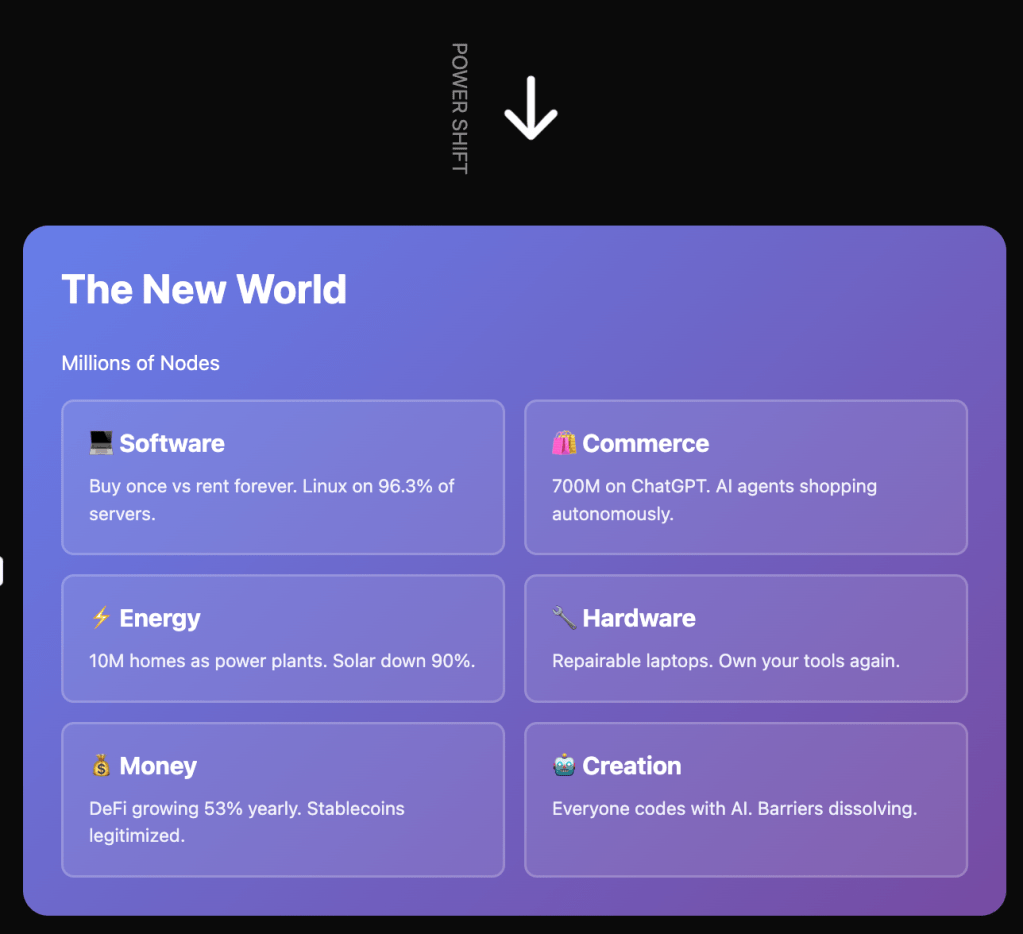
Rails World 2025 just wrapped up in Amsterdam (literally two days ago!), and while I wasn’t there, I’ve been catching up on all the buzz. Last year at Rails World 2024, DHH unveiled OMAKUB – basically Ubuntu Linux that you can set up with one command. But here’s what stuck with me: Linux runs on 96.3% of the top one million web servers. This free, open-source operating system that thousands of developers have worked on for 30+ years essentially is the internet.
Then earlier this year, 37signals dropped Campfire – a chat tool like Slack that you buy once for $299 and host yourself. No monthly fees. Forever. DHH literally ran a conference chat from a computer in his closet to prove the point. In his blog post about it, he said it best: “SaaS has been ruling the world of web-based software for two decades now… But there’s also a lot of SaaS that does not need to be a service.”
Why does this matter? Because we’ve been sleepwalking into a world where we rent everything and own nothing.
The “Why Are We Doing This?” Moment
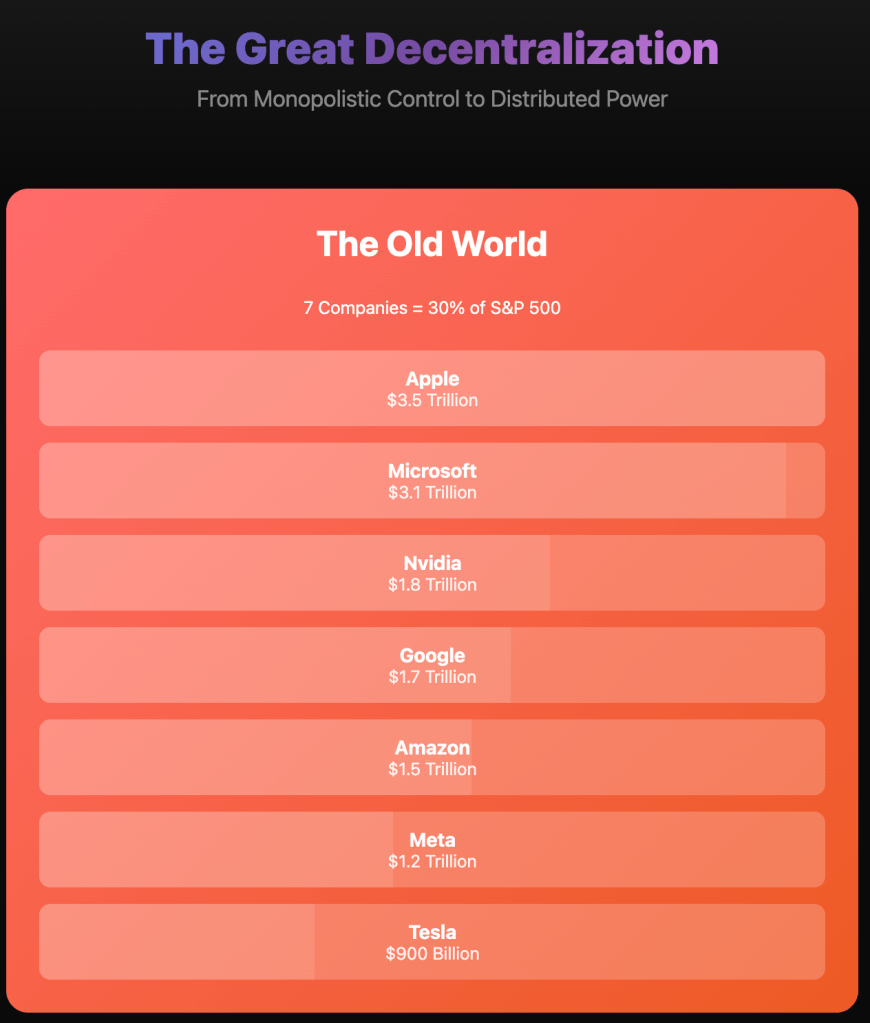
Let’s be real for a second. Why are five companies basically running the American economy? Why does every business decision, every communication, every piece of data flow through the same handful of Silicon Valley giants?
I’m not saying these companies are evil. They built incredible things. But we’ve reached a point where the concentration of power doesn’t make sense anymore. The tools to build alternatives exist. The hardware is powerful enough. The networks are fast enough.
So why are we still paying monthly fees forever just to chat with our coworkers?
Chamath Palihapitiya, the former Facebook exec turned venture capitalist, has been saying this for years. He famously called social media tools “ripping apart the social fabric of how society works” and predicted big tech companies will be “taxed to death” and face regulatory breakup. Back in May 2024 on the All-In Podcast (at the 53:00 mark), he predicted Bitcoin could hit $500,000 by October 2025 – we’re just a month away from his deadline, and while we’re not quite there yet, the momentum toward decentralization he was talking about is undeniable.
The Commerce Revolution I’m Actually Excited About
As someone in commerce, this shift is personal for me. For too long, online selling meant choosing between Amazon, Shopify, or maybe one or two other platforms. A handful of retailers have controlled how products reach consumers.
But that’s changing. Fast.
We’re seeing:
- Creator commerce where individuals build direct relationships with customers
- Video commerce that’s more like QVC meets TikTok than traditional e-commerce
- Decentralized marketplaces where sellers actually own their customer relationships
- Token-based systems that let communities govern themselves while still maintaining order
The DeFi market is projected to grow from $20.48B in 2024 to $231.19B by 2030 – that’s a 53.7% annual growth rate. This isn’t chaos – it’s organized decentralization. We can have rules and systems without having overlords.
The Hardware Finally Catches Up (And My Personal Connection)
Ok, here’s where it gets personal for me. I grew up in the 80s and 90s, and man, those were beautiful times for a computer nerd. From kindergarten through high school, I spent my days at my dad’s computer shop. Seven days a week, we were building PCs, servicing PCs, living and breathing PCs.
I watched us go from DOS to Windows 3.1 (which was mind-blowing at the time), then to Windows 95, which felt like the future had arrived. We were constantly upgrading – swapping out sound cards (remember Sound Blaster?), video cards, adding memory. Going from a 256MB hard drive to 512MB felt like you’d just bought a mansion. Every component was a choice, an upgrade path, a possibility.
Then laptops happened. And suddenly, you buy a MacBook, something breaks, you buy a new MacBook. Dell laptops? Same story. The whole beautiful ecosystem of modular computing just… died. It’s been insane, honestly.
Enter Framework. They’re making laptops where you can swap out ANY component. Screen breaks? Replace the screen. Need a faster processor? Swap it out. Want better graphics? Pop in a new module – takes 5 minutes. They announced earlier this year you can upgrade from an RX 7700S to an RTX 5070 in their Framework 16.
And here’s the beautiful part: AMD’s latest chips are now legitimately competitive with Apple’s M-series. You can get MacBook-level performance in a machine you actually own and can repair. For someone who grew up in the era of “open it up and tinker,” this feels like coming home.
Linus Tech Tips invested $225,000 of his own money in Framework because he believes in this vision so strongly. The Framework laptop got a 10/10 repairability score from iFixit. For the past decade, laptops have been expensive disposable items. That’s ending.
The Money Thing We Need to Talk About
The U.S. is now actively moving on cryptocurrency regulation and adoption. The GENIUS Act (Guiding and Establishing National Innovation for U.S. Stablecoins of 2025) was just signed into law in July 2025 – creating the first federal regulatory framework for stablecoins. This bipartisan legislation, which passed 68-30 in the Senate and 308-122 in the House, requires stablecoins to be backed 1:1 by US dollars or low-risk assets.
Major banks like JPMorgan Chase and retailers like Amazon and Walmart are already planning to issue their own stablecoins. The Act positions the US to lead the global digital currency revolution while strengthening the dollar’s reserve currency status – stablecoins will actually drive demand for US Treasuries. Additionally, 19 US states have introduced Bitcoin reserve legislation as of late 2024.
Whether you love or hate crypto, you can’t ignore what this represents: even governments are recognizing that centralized control of money might not be the only way forward.
This isn’t about becoming a crypto bro. It’s about recognizing that the fundamental structures of our economy are becoming more distributed. And that’s probably healthy.
What This Actually Means for Regular People
Here’s why I’m writing this on a Sunday morning, coffee in hand, genuinely excited about the future:
We’re becoming creators, not just consumers.
When I fire up Cursor and start building something, I’m not trying to create the next unicorn startup. I’m solving my own problems. Creating tools for my specific needs. The stats are wild – 76% of developers are using or planning to use AI coding assistants, and they’re seeing 26% productivity increases.
But here’s the real kicker – you don’t need to be a developer anymore. I’m living proof. Six months ago, code was gibberish to me. Now I’m building stuff. Not perfect stuff, not production-ready stuff necessarily, but MY stuff. Tools that solve MY problems.
This is the real revolution: The barriers between “technical” and “non-technical” people are dissolving. My kids will grow up in a world where creating software is as normal as creating a PowerPoint presentation is today.
The Framework for Everything
What we’re seeing isn’t just about Linux or laptops or Bitcoin. It’s a fundamental shift in how we think about ownership, creation, and power:
- Own, don’t rent – Whether it’s software (Campfire for $299 once), hardware (Framework laptops), or digital assets
- Build for yourself – The tools are accessible enough that you can solve your own problems (I’m doing it with Cursor!)
- Participate, don’t just consume – Whether it’s open source, DAOs, or creator economies
- Modularity over monoliths – In hardware, software, and business models
Where We Go From Here
The beautiful thing about this movement is that it’s not theoretical. You can participate today:
- Try Linux: With tools like OMAKUB, it’s genuinely easy now – one command and you’re running
- Build something: Even if you’re not technical, tools like Cursor make it possible (trust me, if I can do it…)
- Buy hardware that lasts: Framework laptops exist today – and they’re actually good
- Support decentralized commerce: Buy directly from creators when possible
- Question the subscription model: Do you really need to rent that software forever?
The Bottom Line
We’re living through a profound shift. The age of five companies controlling everything is ending. Not because of regulation or revolution, but because better alternatives are emerging.
The centralized model made sense when coordination was hard and resources were scarce. But we’re past that now. We have the tools, the networks, and the knowledge to build differently.
What excites me most isn’t the technology itself – it’s what it enables. When everyone can build, when commerce is truly peer-to-peer, when we own our tools instead of renting them, we get a more vibrant, creative, resilient economy.
That’s not just cool. That’s transformative.
And the best part? We’re just getting started. Rails World 2025 just showed us that the community pushing for this change is stronger than ever. The momentum is real. The future is decentralized.
These are my Sunday thoughts as a non-technical person watching the tech world transform. I’m curious – what changes are you seeing in your industry? How is decentralization showing up in your world?
P.S. – If you’re like me and thought coding was impossible, seriously, try Cursor or another AI-assisted tool. You might surprise yourself with what you can build. I sure as hell did.

Resources & Links
Want to dive deeper? Here’s where I’ve been learning:
The Linux/Open Source Revolution
- OMAKUB Official Site – One command to a fully configured Ubuntu
- DHH’s Blog Post on OMAKUB – The philosophy behind it
- Rails World 2025 – Just happened Sept 4-5 in Amsterdam
The ONCE Movement & Campfire
- Campfire Product Page – $299, once, forever
- DHH’s Campfire Announcement
- 37signals ONCE Philosophy – Buy software, don’t rent it
Framework & Modular Hardware
- Framework Laptops – The anti-MacBook
- Framework 16 with upgradeable graphics
- iFixit’s 10/10 repairability review
AI Democratizing Code
- Cursor – The tool that turned me into a “developer”
- Tom’s Guide on Cursor
- AI Coding Assistant Stats
Bitcoin & Decentralized Finance
- GENIUS Act Information – Stablecoin regulation framework
- All-In Podcast – Chamath’s $500k Bitcoin prediction (May 31, 2024 @ 53:00)
- DeFi Market Analysis
The Numbers Behind It All
- Linux Server Statistics – 96.3% of top web servers
- Web3 Statistics & Trends
Note: Yeah, I went down quite the rabbit hole researching all this. But that’s what Sunday mornings are for, right?
 Hey, I’ve Been Thinking…