Tag: writing

  • Week in Tech #3: From the Moon to Your Shopping Cart, What Actually Happened This Week

    Week in Tech #3: From the Moon to Your Shopping Cart, What Actually Happened This Week

    April 5, 2026

    One of my favorite things to do on Sundays is go through everything I read, researched, and worked on during the week and try to make sense of it. I started doing this publicly a few weeks ago. You don’t need to be technical to follow along. You don’t need to be in the industry. You just need to be curious about where things are heading.

    This was one of those weeks where the headlines feel like they’re from different centuries. On one end, astronauts left Earth for the Moon for the first time since the Nixon administration. On the other end, the Department of Transportation said they’re not interested in AI chatbots. Both things happened in the same seven days.

    That contrast is kind of the theme. Let me walk through it.

    We sent humans to the Moon again

    Artemis II launched from Kennedy Space Center on Tuesday, April 1st. Four astronauts: Commander Reid Wiseman, Pilot Victor Glover, Mission Specialists Christina Koch and Jeremy Hansen from the Canadian Space Agency. They’re on a roughly 10 day trip around the Moon aboard the Orion spacecraft.

    This is the first time human beings have left Earth orbit in 53 years. The last time this happened was Apollo 17. December 1972. Most people reading this were not alive.

    I want to talk about the decision making behind this because I think that’s the real story, not the engineering specs. NASA had been building toward this orbital station called Gateway for years. They looked at it, decided it wasn’t the right path, and scrapped it. Pivoted to permanent Moon bases instead. They also announced a nuclear powered Mars mission for 2028. And they did all of this while the White House proposed cutting NASA’s budget by 24% and its workforce by 32%.

    And they still launched on the first attempt.

    By April 2nd, Orion completed its translunar injection burn and left Earth orbit for good. Jeremy Hansen said from space: “Humanity has once again shown what we are capable of.” By the end of this week, they were approaching the Moon and preparing for a flyby that will break Apollo 13’s all time human distance record by over 4,000 miles. They’re planning to recreate the famous “Earthrise” photograph from Apollo 8. Victor Glover sent an Easter message from space.

    I keep coming back to this because the lesson isn’t about rockets. It’s about focus. An organization under enormous pressure decided to do fewer things and do them right. They killed a project that wasn’t working, redirected toward something more ambitious, and shipped. First principles thinking. That’s what building a nation looks like. That’s what American ingenuity looks like. Science, technology, innovation, and the courage to make hard calls. I don’t care what side of any debate you’re on. That kind of leadership is inspiring. Politics agnostic. Full stop.

    It’s not just about the cool technical achievements. What hasn’t been done in decades is now happening because of focused leadership, speed in decision making, and a willingness to prioritize. That’s what I think we need to see more of everywhere. Not just at NASA.

    Also worth mentioning: SpaceX filed for what could be the largest IPO in history this same week, targeting a $1.75 trillion valuation. And ULA launched a record 29 Amazon satellites on a single Atlas V. Space is becoming a real industry, not just a government program.

    Gemma 4 and why Google deserves more credit than they get

    A little background for anyone who doesn’t track this world closely.

    Google published a research paper in 2017 called “Attention Is All You Need” that introduced the transformer architecture. That’s the core technology underneath every AI model that exists today. ChatGPT was built on it. Claude was built on it. Every one of them. Google also invented the TPU, the custom chip that made training these models at scale even possible. And back in 2014, when Sergey Brin and Larry Page were still running the company hands on, they acquired DeepMind, which became one of the most important AI research labs in the world.

    So when people talk about the AI revolution, Google literally built the foundation. Everyone else is building on top of what they created.

    And what they keep doing, which I think doesn’t get enough attention, is making it available to everyone.

    On April 2nd, they released Gemma 4. Four model sizes. Fully open source under the Apache 2 license, meaning anyone can use it for any purpose: commercial, personal, modify it, build products on it. No restrictions. The smallest version runs on a phone. The biggest competes with frontier models from any lab and handles text, images, video, and audio all in one model.

    The one that caught my eye is the 26 billion parameter version that only activates about 4 billion parameters at a time. It’s like a big engine that cruises on four cylinders when it can. It scores nearly as high as Google’s full 31 billion parameter dense model but uses way less compute. That’s meaningful for anyone thinking about running AI locally or at scale without massive costs.

    400 million+ downloads since the Gemma family launched. Over 100,000 community variants people have built on top of it. They also released specialized versions for medical, translation, security, and embeddings. And they built it into Android’s on device AI system so developers can run Gemma 4 natively on phones.

    I’m downloading it right now to test on my Mac Studio. The fact that I can run a model this capable on a machine sitting on my desk, for free, is kind of amazing.

    The company that invented this technology is supporting the community and the ecosystem by keeping it open. In a world where everyone’s trying to build walled gardens, I think that deserves to be called out.

    AI is about to change how we buy things online, and most sellers aren’t ready

    This is the section I care about most personally because I sell products across Amazon, Shopify, Wayfair, TikTok Shop, and wholesale every single day.

    Google and Shopify co-developed the Universal Commerce Protocol. In simple terms: it’s a shared set of rules that lets AI assistants actually shop for you. When you ask ChatGPT or Google Gemini to find you a product, this protocol is what allows the AI to browse a store, understand what’s available, handle checkout, and manage returns, all without the store needing a custom connection to every AI platform.

    This matters because shopping is moving into conversations. Not websites, not apps. Conversations. And Shopify’s data shows it’s happening now: traffic from AI tools up 7x since January, purchases from AI searches up 11x. They launched Agentic Storefronts to let millions of merchants sell directly inside AI chats.

    Over 20 major companies backing it: Walmart, Target, Stripe, Visa, Mastercard, Home Depot, Wayfair, Etsy. The open source spec is live at ucp.dev. Shopify’s engineering team published a deep dive on how the architecture works.

    The competitive angle: OpenAI tried building shopping directly inside ChatGPT and it didn’t work well. Walmart’s internal data showed conversion rates were 3x lower when people bought directly in ChatGPT compared to being sent to the retailer’s own site. So OpenAI is pivoting to an app model. Google and Shopify are building the universal rail. As an operator, that’s the one I’m watching.

    The question I’m asking myself: is my catalog ready for agents? If an AI can’t find my products, describe them correctly, and process a purchase, I’m invisible to whatever shopping looks like in two years.

    On Toby Lutke’s AI memo: Just turned one year old. The one where the Shopify CEO said AI usage is now a fundamental expectation and teams need to show AI can’t do the job before asking for headcount. A year later, the results are in the product. This week: new API with B2B wholesale, tariff support, translated metafields. They shipped.

    On tariffs: April 2nd was the one year anniversary of “Liberation Day” and the situation got worse, not better. 100% tariff on patented pharmaceuticals. Strengthened duties on metals, 200% on Russian aluminum. Effective tariff rate hit 11%, highest since 1943. Amazon adding 3.5% surcharges on FBA. Framework Laptop paused U.S. sales on some models because they’d sell at a loss.

    I live this. Every week I’m negotiating with Turkish factories on raw material increases caused by the same forces. The compliance paperwork alone hits small companies disproportionately.

    Robots are not slowing down

    Multiple developments worth knowing about.

    Figure AI demonstrated Figure 03. Third generation, designed for real production. They’re assembling one robot roughly every 90 minutes. That’s a production line, not a prototype shop. I’m gonna watch the full demo walkthrough this week. Excited about this one.

    Boston Dynamics and Hyundai announced plans to deploy “tens of thousands” of robots across manufacturing. Here’s the context most coverage misses: Hyundai owns Boston Dynamics. They acquired them. So the parent company just became the biggest customer of its own subsidiary. That’s not a test run. That’s a corporate level strategic bet. DHL also signed on for another 1,000 robots.

    Generalist AI released GEN-1, an embodied AI model claiming 99% task success where previous models hit 64%. The novel part: it trains on 500,000+ hours of human wearable data, not robot data, and then only needs about an hour of robot specific tuning.

    Unitree filed for their IPO. Revenue from 123 million yuan in 2022 to 1.7 billion yuan in 2025. Their humanoid starts at $29,900.

    ProRL Combine is confirmed for April 19th in Boston. America’s first robot sports competition. Same day as Beijing’s humanoid robot half marathon. I’m gonna try to go to Boston for it. If anyone else is heading there, hit me up: adem@wellwoven.com.

    The AI money race and things that made me go hmm

    OpenAI closed $122 billion at an $852 billion valuation. Largest private funding round in history. Amazon $50B, SoftBank $30B, Nvidia $30B. Over 900 million weekly active users. IPO expected later this year.

    I’m still using Claude as my daily driver. It’s been fantastic. But you can’t ignore what $122 billion means for where this industry is going.

    Microsoft launched their own AI models this week, completely separate from OpenAI: speech to text, voice, image generation. Their speech model has the lowest error rate of anything available. Mustafa Suleyman said “we’re now a top three lab.” Microsoft paying $13 billion for OpenAI and then building competing models in house. That’s corporate strategy at its finest.

    Anthropic and the Pentagon are in a legal fight after Anthropic refused to let Claude be used for mass surveillance or lethal autonomous weapons. A federal judge called the blacklisting “Orwellian.” Ninth Circuit appeal deadline is April 30th. This one is going to matter a lot.

    Anthropic also blocked third party tools from running on subscription credits. OpenClaw on your Claude subscription? Done. Pay as you go only. I think that’s whack but I get the business logic.

    OpenAI acquired TBPN, the daily tech show on YouTube. If you haven’t seen it, it’s actually a pretty fresh take on tech and business. Been growing on me. First media acquisition by an AI company. Money talks, people.

    GPT-4o officially retired.

    On the tools I’m using: Cursor 3.0 shipped this week and I just upgraded. The new worktree command and best of n command (run multiple agents on the same task, pick the winner) are cool and I’m going to test them. But I’ll be honest, I’ve been moving toward Claude Code more and more lately. I used to love Cursor for the interface, the file directory on the left side, seeing the agents work on the side. It felt more descriptive, especially getting started. But Claude Code in plan mode lets you see everything it’s about to do before it does it. That’s genuinely useful.

    And here’s the thing that surprised me this weekend: developing from my phone. I know mobile coding has existed in different forms for different tools. This is my first time really playing with it. And it’s amazing. Probably going to be addictive. I’ll report back on how it works in practice.

    Healthcare AI is starting to deliver real results

    This section makes me genuinely happy.

    Eli Lilly signed a $2.75 billion deal with Insilico Medicine for drug candidates discovered by AI. Their first compound went from identifying the target to starting human trials in under 30 months. That normally takes four to six years. As of early 2026, over 173 AI discovered programs are in clinical development, with Phase I success rates running 80 to 90% compared to the historical average of 52%.

    Butterfly Network got FDA clearance for an AI powered ultrasound tool that estimates gestational age in under two minutes without needing a trained sonographer. Nearly half of rural U.S. counties don’t have hospital obstetric services. This tool brings that capability to the places that need it most. It’s already deployed in Malawi and Uganda.

    Mount Sinai deployed AI across all seven of its hospitals, integrated directly into their electronic health records. Clinicians ask questions in natural language and get evidence backed answers with citations.

    The VA deployed agentic AI across 150 medical centers. Scheduling went from “a handful” of appointments per day to 25. VR therapy expanding to 45 more centers showing 46.7% pain reduction.

    Here’s what I hope comes from all of this. I hope costs come down. I hope quality goes up. I hope diagnosis gets faster and more accurate and more accessible to people regardless of where they live or what they can afford. The business of healthcare has been this big complicated opaque expensive machine for too long. If AI can help democratize the knowledge and wisdom of medicine, if it can bring that information and that capability down to all of us, that’s the whole point. That’s what technology is supposed to do. I don’t know the perfect way to say it but I think most people feel the same.

    On the war

    I want to say this briefly and carefully because this is a technology newsletter, not a political one.

    The conflict continues to affect everyone, and as someone who imports physical goods, it’s in my world every day. Raw material costs are spiking. Conversations with suppliers are harder. There’s a lot of uncertainty about where things are going and what costs look like over the coming months.

    I don’t want to get political about it. I just want to say I’m hoping for peace. I think most of us are. It’s a terrible situation. My heart goes out to everyone affected by it. We just hope this resolves and the world starts to heal.

    The contrast: rapid acceleration and stubborn stagnation

    I want to end here because this has been on my mind all week.

    Rockets to the Moon. $122 billion funding rounds. Robots assembled every 90 minutes. Open source AI you can run on your laptop. Healthcare diagnosis in two minutes.

    And then:

    Google found that 80% of public servants believe AI could help them do their jobs. Only 18% think their governments actually use it well. That’s a 62 point gap between believing it works and actually deploying it.

    The DOT explicitly rejected AI chatbots this week. They’re consolidating 60 apps into 7 platforms. Expected timeline: 2028 or 2029.

    3D printed homes were supposed to cut housing costs in half. They sell for $375,000 to $600,000. Real savings: 5 to 15%.

    The UK’s government data portal has 25% broken links and surfaces outdated datasets. You can’t build AI on top of broken infrastructure.

    But there are bright spots. Maryland saved $400K using AI across 40,000 employees. Dearborn, Michigan resolves 70% of city calls with an AI chatbot in over 100 languages. Connecticut cut forensic investigation times from months to hours.

    The pattern is isolated proof points, not systemic change. The innovation exists. The institutions, the procurement rules, the regulations, they’re not ready.

    It’s an interesting time to be alive. Some things are moving at a speed that’s hard to comprehend. Other things feel like they haven’t moved in years. That gap between what’s possible and what’s actually deployed is the defining story of this moment.

    And honestly, closing that gap doesn’t require more technology. It requires patience. Education. And a willingness to sit down and actually understand what’s happening.

    Be patient. Do the work. Pay attention. That’s what I’m trying to do. That’s all any of us can do.


    I’m Adem Ogunc. I’m the founder of Well Woven, a rug importing and e-commerce company based in Easton, PA, and FurniPulse, a furniture industry intelligence platform. One of my favorite things to do on Sundays is sit down and go through what happened in technology. I do it because I think understanding technology is the most important skill of the next decade, and it shouldn’t require a CS degree or insider language to get into it. Issue #3. Thanks for reading. See you next week.

  • Sunday Thoughts: We’re All Becoming Builders in the Decentralization Era

    I’m not a developer. Let me just get that out there. I’m a commerce guy who gets excited about technology, and what I’m seeing right now is blowing my mind.

    Six months ago, I couldn’t have imagined writing a line of code. Today? I’m playing around with Cursor, experimenting with no-code tools, and I’ve actually got an IDE running on my Mac. Am I building the next Facebook? No. But I’m creating small, useful software for my specific needs. And that’s the point – we’re entering an era where everyone can be a builder.

    The Great Unbundling

    Here’s what hit me this week: Everything is decentralizing, and it’s happening faster than most people realize.

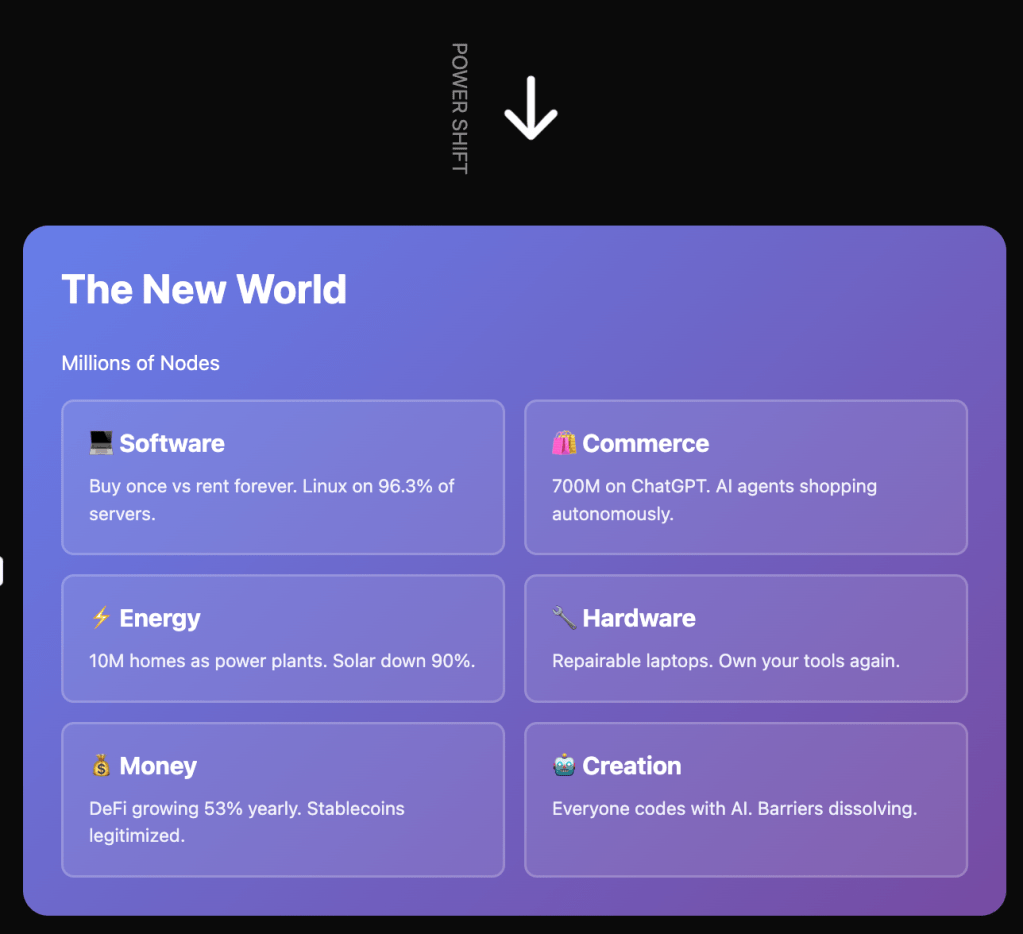
    Rails World 2025 just wrapped up in Amsterdam (literally two days ago!), and while I wasn’t there, I’ve been catching up on all the buzz. Last year at Rails World 2024, DHH unveiled OMAKUB – basically Ubuntu Linux that you can set up with one command. But here’s what stuck with me: Linux runs on 96.3% of the top one million web servers. This free, open-source operating system that thousands of developers have worked on for 30+ years essentially is the internet.

    Then earlier this year, 37signals dropped Campfire – a chat tool like Slack that you buy once for $299 and host yourself. No monthly fees. Forever. DHH literally ran a conference chat from a computer in his closet to prove the point. In his blog post about it, he said it best: “SaaS has been ruling the world of web-based software for two decades now… But there’s also a lot of SaaS that does not need to be a service.”

    Why does this matter? Because we’ve been sleepwalking into a world where we rent everything and own nothing.

    The “Why Are We Doing This?” Moment

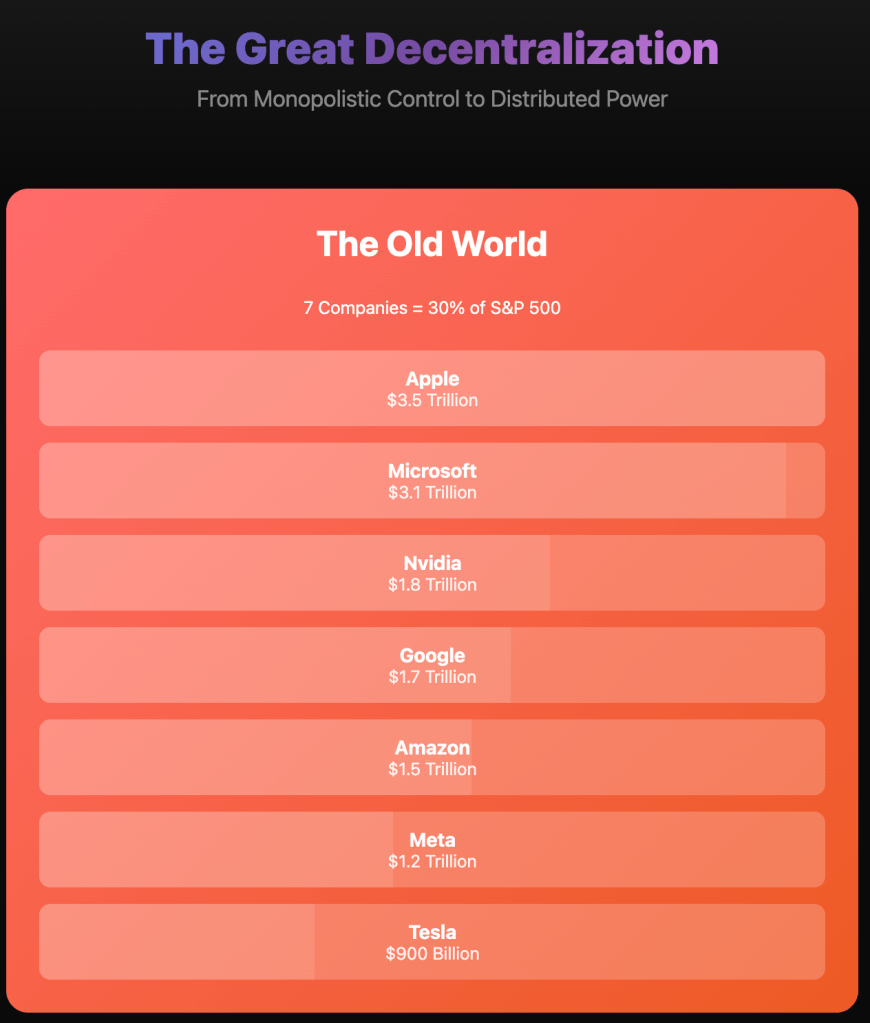
    Let’s be real for a second. Why are five companies basically running the American economy? Why does every business decision, every communication, every piece of data flow through the same handful of Silicon Valley giants?

    I’m not saying these companies are evil. They built incredible things. But we’ve reached a point where the concentration of power doesn’t make sense anymore. The tools to build alternatives exist. The hardware is powerful enough. The networks are fast enough.

    So why are we still paying monthly fees forever just to chat with our coworkers?

    Chamath Palihapitiya, the former Facebook exec turned venture capitalist, has been saying this for years. He famously called social media tools “ripping apart the social fabric of how society works” and predicted big tech companies will be “taxed to death” and face regulatory breakup. Back in May 2024 on the All-In Podcast (at the 53:00 mark), he predicted Bitcoin could hit $500,000 by October 2025 – we’re just a month away from his deadline, and while we’re not quite there yet, the momentum toward decentralization he was talking about is undeniable.

    The Commerce Revolution I’m Actually Excited About

    As someone in commerce, this shift is personal for me. For too long, online selling meant choosing between Amazon, Shopify, or maybe one or two other platforms. A handful of retailers have controlled how products reach consumers.

    But that’s changing. Fast.

    We’re seeing:

    • Creator commerce where individuals build direct relationships with customers
    • Video commerce that’s more like QVC meets TikTok than traditional e-commerce
    • Decentralized marketplaces where sellers actually own their customer relationships
    • Token-based systems that let communities govern themselves while still maintaining order

    The DeFi market is projected to grow from $20.48B in 2024 to $231.19B by 2030 – that’s a 53.7% annual growth rate. This isn’t chaos – it’s organized decentralization. We can have rules and systems without having overlords.

    The Hardware Finally Catches Up (And My Personal Connection)

    Ok, here’s where it gets personal for me. I grew up in the 80s and 90s, and man, those were beautiful times for a computer nerd. From kindergarten through high school, I spent my days at my dad’s computer shop. Seven days a week, we were building PCs, servicing PCs, living and breathing PCs.

    I watched us go from DOS to Windows 3.1 (which was mind-blowing at the time), then to Windows 95, which felt like the future had arrived. We were constantly upgrading – swapping out sound cards (remember Sound Blaster?), video cards, adding memory. Going from a 256MB hard drive to 512MB felt like you’d just bought a mansion. Every component was a choice, an upgrade path, a possibility.

    Then laptops happened. And suddenly, you buy a MacBook, something breaks, you buy a new MacBook. Dell laptops? Same story. The whole beautiful ecosystem of modular computing just… died. It’s been insane, honestly.

    Enter Framework. They’re making laptops where you can swap out ANY component. Screen breaks? Replace the screen. Need a faster processor? Swap it out. Want better graphics? Pop in a new module – takes 5 minutes. They announced earlier this year you can upgrade from an RX 7700S to an RTX 5070 in their Framework 16.

    And here’s the beautiful part: AMD’s latest chips are now legitimately competitive with Apple’s M-series. You can get MacBook-level performance in a machine you actually own and can repair. For someone who grew up in the era of “open it up and tinker,” this feels like coming home.

    Linus Tech Tips invested $225,000 of his own money in Framework because he believes in this vision so strongly. The Framework laptop got a 10/10 repairability score from iFixit. For the past decade, laptops have been expensive disposable items. That’s ending.

    The Money Thing We Need to Talk About

    The U.S. is now actively moving on cryptocurrency regulation and adoption. The GENIUS Act (Guiding and Establishing National Innovation for U.S. Stablecoins of 2025) was just signed into law in July 2025 – creating the first federal regulatory framework for stablecoins. This bipartisan legislation, which passed 68-30 in the Senate and 308-122 in the House, requires stablecoins to be backed 1:1 by US dollars or low-risk assets.

    Major banks like JPMorgan Chase and retailers like Amazon and Walmart are already planning to issue their own stablecoins. The Act positions the US to lead the global digital currency revolution while strengthening the dollar’s reserve currency status – stablecoins will actually drive demand for US Treasuries. Additionally, 19 US states have introduced Bitcoin reserve legislation as of late 2024.

    Whether you love or hate crypto, you can’t ignore what this represents: even governments are recognizing that centralized control of money might not be the only way forward.

    This isn’t about becoming a crypto bro. It’s about recognizing that the fundamental structures of our economy are becoming more distributed. And that’s probably healthy.

    What This Actually Means for Regular People

    Here’s why I’m writing this on a Sunday morning, coffee in hand, genuinely excited about the future:

    We’re becoming creators, not just consumers.

    When I fire up Cursor and start building something, I’m not trying to create the next unicorn startup. I’m solving my own problems. Creating tools for my specific needs. The stats are wild – 76% of developers are using or planning to use AI coding assistants, and they’re seeing 26% productivity increases.

    But here’s the real kicker – you don’t need to be a developer anymore. I’m living proof. Six months ago, code was gibberish to me. Now I’m building stuff. Not perfect stuff, not production-ready stuff necessarily, but MY stuff. Tools that solve MY problems.

    This is the real revolution: The barriers between “technical” and “non-technical” people are dissolving. My kids will grow up in a world where creating software is as normal as creating a PowerPoint presentation is today.

    The Framework for Everything

    What we’re seeing isn’t just about Linux or laptops or Bitcoin. It’s a fundamental shift in how we think about ownership, creation, and power:

    • Own, don’t rent – Whether it’s software (Campfire for $299 once), hardware (Framework laptops), or digital assets
    • Build for yourself – The tools are accessible enough that you can solve your own problems (I’m doing it with Cursor!)
    • Participate, don’t just consume – Whether it’s open source, DAOs, or creator economies
    • Modularity over monoliths – In hardware, software, and business models

    Where We Go From Here

    The beautiful thing about this movement is that it’s not theoretical. You can participate today:

    • Try Linux: With tools like OMAKUB, it’s genuinely easy now – one command and you’re running
    • Build something: Even if you’re not technical, tools like Cursor make it possible (trust me, if I can do it…)
    • Buy hardware that lasts: Framework laptops exist today – and they’re actually good
    • Support decentralized commerce: Buy directly from creators when possible
    • Question the subscription model: Do you really need to rent that software forever?

    The Bottom Line

    We’re living through a profound shift. The age of five companies controlling everything is ending. Not because of regulation or revolution, but because better alternatives are emerging.

    The centralized model made sense when coordination was hard and resources were scarce. But we’re past that now. We have the tools, the networks, and the knowledge to build differently.

    What excites me most isn’t the technology itself – it’s what it enables. When everyone can build, when commerce is truly peer-to-peer, when we own our tools instead of renting them, we get a more vibrant, creative, resilient economy.

    That’s not just cool. That’s transformative.

    And the best part? We’re just getting started. Rails World 2025 just showed us that the community pushing for this change is stronger than ever. The momentum is real. The future is decentralized.

    These are my Sunday thoughts as a non-technical person watching the tech world transform. I’m curious – what changes are you seeing in your industry? How is decentralization showing up in your world?

    P.S. – If you’re like me and thought coding was impossible, seriously, try Cursor or another AI-assisted tool. You might surprise yourself with what you can build. I sure as hell did.

    Resources & Links

    Want to dive deeper? Here’s where I’ve been learning:

    The Linux/Open Source Revolution

    The ONCE Movement & Campfire

    Framework & Modular Hardware

    AI Democratizing Code

    Bitcoin & Decentralized Finance

    The Numbers Behind It All

    Note: Yeah, I went down quite the rabbit hole researching all this. But that’s what Sunday mornings are for, right?

  • Why I Built a Furniture Industry News Aggregator (Because 12 Browser Tabs Was Too Many)

    I’m sitting in our warehouse this Sunday morning, July 13th, surrounded by moving boxes. We just wrapped our team meeting, and I finally have time to share something I’ve been building in the evenings after the kids go to bed.

    If you work in home furnishings—whether you’re a buyer, designer, manufacturer, or retailer—you know the morning ritual. Open Furniture Today. Check Home Accents Today. Scan Architectural Digest. Pop over to Apartment Therapy. By the time your coffee’s lukewarm, you’ve got a dozen tabs open and you’re still not sure you caught everything important.

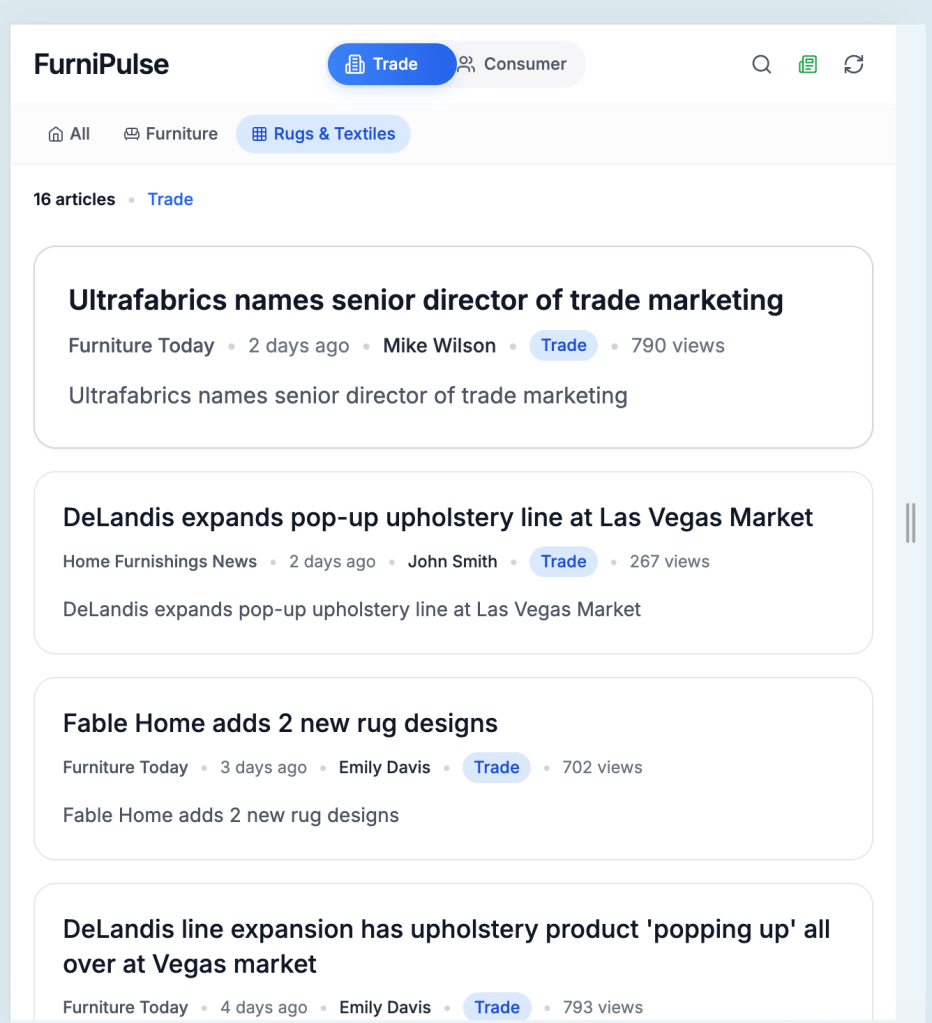
    Last month, I decided to come up with a solution. The result? FurniPulse—a simple tool that pulls 19+ furniture industry sources into one clean feed, updated every 20 minutes.

    screenshot of the homepage of furnipulse.com

    The Pulse of the Business

    In the furniture industry, any good company needs to know where the consumer mindset is and what’s happening in the competitive landscape. There’s SO much going on all the time—new collections dropping, trends shifting, competitors making moves, trade shows approaching.

    (Quick sidebar: you need to know what’s going on, but you also need your own vision. Like, I check what West Elm is doing, but I’m not trying to BE West Elm, you know? It’s more like… okay, they’re pushing curved sofas hard this season. Good to know. But maybe my customers are still loving their sectionals. You can’t just chase every trend—you’ll drive yourself crazy and lose what makes you unique.)

    If I’m being perfectly honest, there’s definitely some FOMO mixed in there too. You see a competitor mentioned in a trade pub and think “what are they up to?” Or a design blog features some trend you haven’t heard of and suddenly you’re wondering if you’re behind the curve.

    Every morning, I’d find myself with a dozen tabs open, trying to piece together the full picture. Trade news in one corner telling me about manufacturing changes. Consumer blogs in another showing me how those changes were being spun to the public. Industry announcements scattered across five different sites.

    This is just what we do. It’s part professional necessity, part curiosity, part not wanting to be the last one to know something important. But I kept thinking—there has to be a better way to stay connected to all this without the constant tab juggling.

    So I thought: why not create this for myself? One place where I could actually feel the rhythm of the industry without the morning scramble. A single feed that shows me both sides of the story—what manufacturers are saying and what consumers are reading.

    That’s how FurniPulse was born. Not from crisis or frustration. More from recognizing that this thing we all do—this mix of staying informed and maintaining our own direction—could be simpler.

    Building Without Being a Builder

    Here’s the part that still amazes me: I built this myself. Me. A furniture guy who couldn’t write a line of code six weeks ago.

    With all these AI coding tools dropping—Cursor, Claude, ChatGPT—I started wondering: could I actually build something to solve my own problem? Not hire someone. Not wait six months. Just… build it myself?

    So I did. Over the last few weeks, spending a couple hours each evening, I created FurniPulse. The process was surreal. I’m literally talking to these tools using Whisper AI, explaining what I want like I’m training a really smart intern. Share a screenshot here, describe a feature there, and somehow, working code appears.

    My wife would find me at 11 PM, muttering at my laptop about RSS feeds and Python scripts. “Are you becoming one of those tech guys?” she’d ask. Maybe I am.

    What FurniPulse Actually Does

    At its core, FurniPulse is simple:

    Every 20 minutes, it automatically:

    • Scans 19 trusted sources (and growing)
    • Collects fresh articles—currently tracking 239 articles
    • Organizes by relevance—Trade news for professionals, Consumer news for enthusiasts
    • Delivers instantly—accessible on any device at furnipulse.com

    Two viewing modes:

    • Trade Mode – Industry news, B2B updates, manufacturing insights, tariff announcements
    • Consumer Mode – Design trends, home decor, lifestyle content

    The magic is in seeing both perspectives side by side. You start to notice things.

    The Patterns You Can’t Unsee

    Once I had both trade and consumer feeds in one place, the matrix revealed itself:

    The 48-Hour Rule: Trade news hits consumer blogs 48-72 hours later, like clockwork. Tariff announced Monday? By Wednesday, Apartment Therapy has “5 Ways to Style Your Space Before Prices Rise!”

    The PR Playbook: Product launches follow a script—leaked photo, official announcement, influencer “surprise” post, consumer blog round-up. Every. Single. Time. Now I can practically predict which stories will blow up.

    Market Momentum: Vegas Market prep started ramping up exactly 6 weeks out across every publication. The cascade is so predictable, you could set your calendar by it.

    The Translation Gap: What manufacturers call “supply chain optimization” becomes “Why Your Favorite Sofa Might Cost More” in consumer media. Watching how industry jargon gets translated for consumers is a masterclass in communication.

    The Technical Journey (For Fellow Non-Techies)

    I spent three nights googling “how to parse RSS feeds” before realizing I was massively overthinking it. The fourth night, I had a working prototype.

    The tools I used:

    • Cursor on my Mac (it’s like VS Code but understands plain English)
    • Claude/ChatGPT for problem-solving
    • Whisper AI for voice-to-text (because typing is slow when you’re excited)
    • Python for the backend (which I learned as I went)
    • Some hosting service I still don’t fully understand but it works

    I almost gave up when I realized I’d have to manually categorize 47 different publications. Some use “furnishings,” others “furniture,” and don’t get me started on whether “décor” needs an accent. Then I remembered: done is better than perfect.

    The biggest surprise? It’s ridiculously cheap to run. Like, less than my monthly coffee budget cheap.

    What This Means for Our Industry

    We’re at an inflection point. When a furniture guy can build software by talking to AI at 11 PM, what else becomes possible?

    Think about all the inefficiencies in our industry:

    • Inventory management spreadsheets that haven’t changed since 2003
    • Quote processes that still involve three emails and a PDF
    • Showroom experiences that ignore everything we know about digital retail

    If I can solve my news problem in a few weeks of evenings, what could you build to solve yours?

    The Reality Check

    FurniPulse isn’t perfect. My wife thinks the name is terrible (she’s probably right). I still manually check Dwell because their RSS feed is broken. Sometimes the categorization is wonky—apparently “ottoman” can mean furniture OR the empire, depending on context.

    But every morning when I open one tab instead of twelve, when I catch trends before they hit mainstream, when I save 30 minutes that I can spend on actual business—it’s worth it.

    What’s Next

    Right now, my goal is simple: get feedback. Is this useful beyond my own morning routine? What sources am I missing? How could it be better?

    I’m not thinking about monetization. Maybe sponsors down the line, but that’s a careful road. For now, it costs almost nothing to run, and if it helps others in our industry stay informed, that’s enough.

    Once we get through this warehouse move and into fall, I want to create more tools like this. Share what works. Build in public. Because if there’s one thing I’ve learned, it’s that the gap between “I wish someone would build…” and “I built…” is smaller than ever.

    Try It Yourself

    FurniPulse is live at furnipulse.com. It’s free, it’s basic, but it works.

    If you’re drowning in furniture industry news every morning, give it a try. And if you know of publications I’m missing, please let me know. Currently tracking 19 sources, but our industry is vast and I’m always looking to improve.

    More importantly, if you’ve got your own itch to scratch—that spreadsheet that drives you crazy, that process that wastes hours, that information gap that costs money—maybe it’s time to build your own solution.

    All of us are techies now, whether we admit it or not.

    Drop me a line at adam@woven.com. I’d love to hear what you think, what you’d build, or just commiserate about the state of RSS feeds in 2024.

    Time to get back to these moving boxes. But first, one more coffee and a quick check of FurniPulse. Old habits die hard—they just get more efficient.

    —Adem

    P.S. – Still looking for someone who can fix Dwell’s RSS feed. Coffee and eternal gratitude await.